


I swapped the laptop for three days of mud at EARTH:BODY, an earthen art workshop led by the brilliant Becky Gilling at Wick Farm in Somerset.
The timing was perfect. I’ve got an idea bubbling away for an upcoming garden. I’m keeping the details under wraps for now, but I wanted to understand earth properly as a creative and construction material, not just through photographs and reference projects. There’s only so much you can learn from a screen. Sometimes you need to get your hands in the mud.
Starting with what was beneath our feet
Over the three days, we worked together to create an earthen shrine: a place where people could pause, connect with the earth and make a prayer for her.
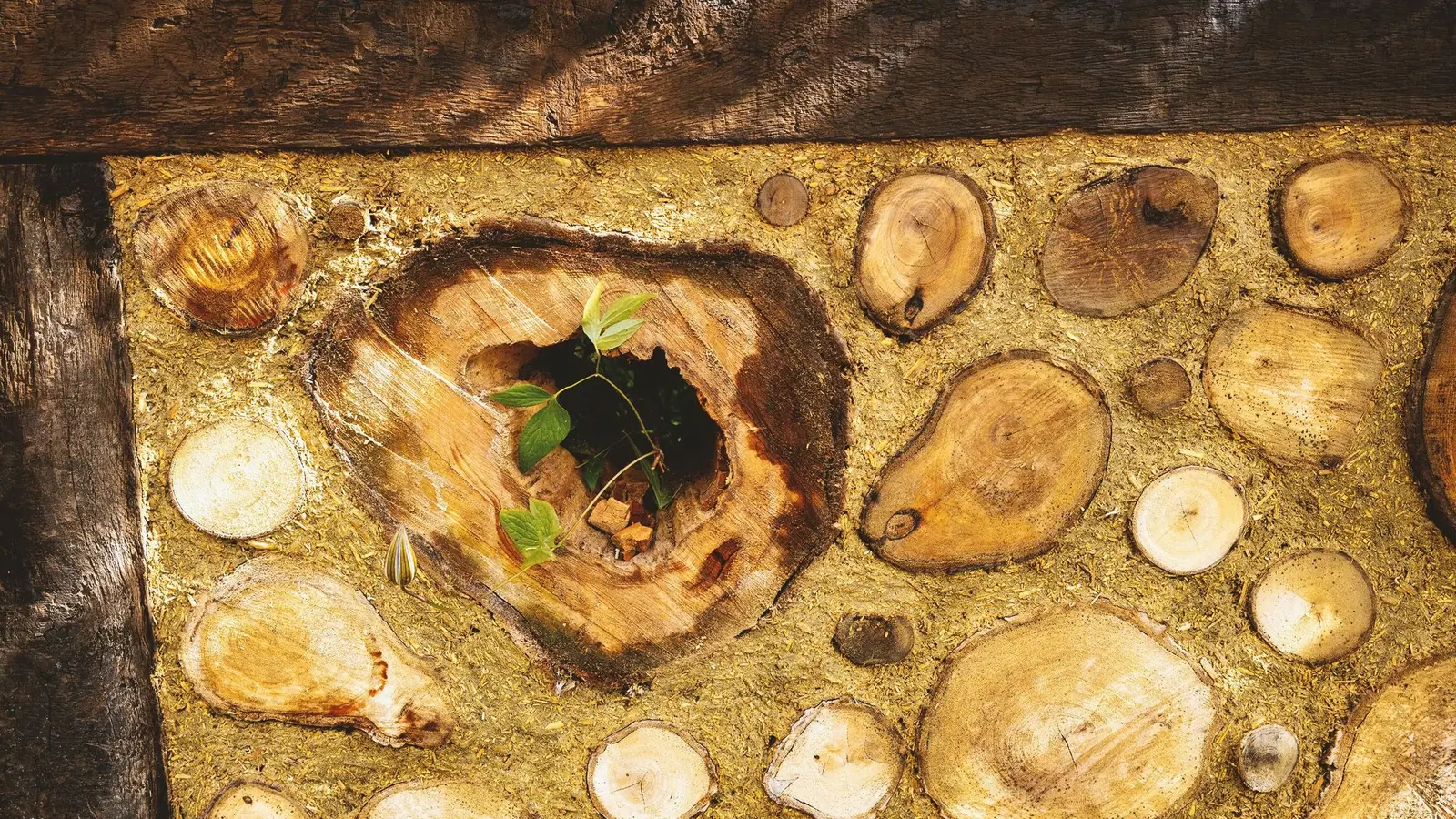
We started with clay-rich soil dug directly from Wick Farm. We processed the soil, prepared the different mixtures, built an armature and gradually applied the mud to form the main structure. As it developed, we added more sculptural and decorative details.
What I loved was how directly the finished piece connected to the place. It wasn’t a sculpture made elsewhere and dropped into the landscape. It was quite literally shaped from the land around it.
It turns out mud isn’t just mud
One of the most useful parts of the workshop was learning how clay behaves when it is used for sculpture and larger three-dimensional forms. It quickly became clear that there isn’t one standard mud recipe. Different fibres and aggregates completely change how a mixture behaves. They can affect:
- How easy it is to apply and shape
- How well it grips the supporting structure
- How much it shrinks or cracks
- Its strength and weight
- The level of detail it can hold
- The texture of the finished surface
Some mixtures are better for building strength and volume quickly. Others suit fine sculpting, surface finishes and decorative details.
Working directly with the materials helped me understand when a mixture felt right and when it needed adjusting. That sort of knowledge is difficult to pick up from a book. You need to mix it, squeeze it, apply it and occasionally watch it fall off again.
We also explored different construction methods, and how the armature, base layers and finishing coats all work together.

A big shout-out to Becky
A massive thank you to Becky for sharing so much knowledge with us. She made the whole process feel approachable, while still explaining the technical thinking behind it. We weren’t simply shown how to apply mud: we learnt why the different layers, fibres, aggregates and construction methods mattered.
Becky also gave an evening presentation with a behind-the-scenes look at her larger projects. It was fascinating to see how something playful and organic still needs serious thought about structure, scale, weather, materials, organisation and teamwork.
She was generous with her experience and created a space where everyone could experiment without worrying about getting everything perfect. You can find out more about EARTH:BODY on her website.
Why earth feels so accessible
The biggest thing I took away from the workshop was how accessible the medium can be. You don’t need to arrive as an experienced artist, sculptor or builder. You can begin with earth, water, fibre, aggregate, your hands and a willingness to get muddy.
It’s a very forgiving material. You can add to it, reshape it, smooth it, carve it or repair it. If something isn’t working, you can often adjust the mixture and try again.
Accessible doesn’t mean basic, though. With knowledge and imagination, earth can create sophisticated, expressive and completely individual forms.
There’s a low barrier to getting involved, but almost endless room to develop your skills.
Ideas for private gardens
The workshop has sparked plenty of ideas about how clay and earthen construction might work in private gardens. It could be used for sculptural features, decorative surfaces, seating, walls or smaller pieces that feel connected to their surroundings.
Outdoor use needs the right construction, detailing and protection from the weather. That feels like part of the design challenge rather than a reason to dismiss the material.
There’s something appealing about making a garden feature from soil found on the site rather than ordering every component from a catalogue. It gives the finished piece a story and a character that belong to that particular garden.
A way of bringing people together
I’m just as interested in what this could offer charities and community garden projects. The final structure is only one part of it. Making it together could be just as important.
People can help mix the materials, build the form, apply layers or create decorative details. Everyone can contribute something and leave their mark. Working alongside each other also lets conversation happen naturally: you’re focused on a shared task, experimenting together and watching something take shape.
For charities, schools and community groups, an earthen feature could become both a garden element and a shared activity. Rather than being handed a finished space, people could help shape it themselves, and that creates a very different sense of connection and ownership.
An idea taking shape
I originally booked the workshop because of an idea I’m beginning to develop for an upcoming garden. I’m not going to give too much away just yet, but EARTH:BODY has helped turn that early thought into something much more tangible. It has also opened up possibilities I hadn’t considered.
Thank you again to Becky, everyone involved and Wick Farm for a brilliant few days. I came away muddy, full of ideas and slightly obsessed with what might be possible using the earth beneath our feet. And a big shout-out to my friend Wisdom Workz, who joined me on the course.
Filed under Materials matter on 3 September 2026